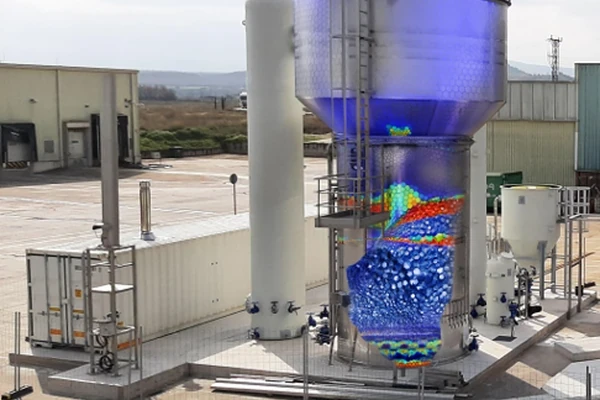
This service develops advanced physics-based simulation models to help manufacturing companies and AI developers understand, predict, and optimise material transformation processes. It enables a clear link between process parameters and final product characteristics, supporting more efficient production, improved quality, and enhanced AI model reliability.
The models provide a theoretical and data-driven foundation for process understanding, offering explainability for AI models and facilitating their integration into industrial applications. By combining physics-based modelling with simulation techniques, companies can reduce trial-and-error experimentation and accelerate innovation.
Model exploration through simulation-based Design of Experiments (DOE) generates physically grounded synthetic datasets. These datasets are used to train, test, and validate data-driven models, improving their robustness and reliability, especially in scenarios where real data is limited or difficult to obtain.
The service includes:
Additionally, these models are used for performance analysis and optimisation. The service includes the proposal and initial evaluation of alternative, complementary, or improved solutions to maximise process capabilities and performance in defined industrial use cases.
The service follows a structured process:
The outputs include simulation models, synthetic datasets, and a technical report describing model behaviour, key insights, and recommendations for process improvement and AI integration. These deliverables support better decision-making, improved process control, and increased trust in AI-based solutions.
Typical applications include optimisation of injection moulding processes, improvement of forming operations, enhancement of additive manufacturing quality, and simulation of chemical processes. For example, companies can reduce defect rates, improve product consistency, or optimise energy consumption through virtual experimentation.
To carry out the service, customers are expected to provide access to process data (e.g. machine parameters, material properties), system specifications, and, where available, validation data from real operations. ITA provides modelling expertise, simulation tools, and computational infrastructure to develop and validate the models.
This service is designed for:
To start a project, companies can contact ITA to define the process and available data. This initial step includes a feasibility assessment, followed by a tailored proposal, model development, validation, and delivery of results.