
From real-world testing to independent validation of AI-based machine monitoring solutions
Introduction
In today’s manufacturing environment, the reliability of machines and the ability to anticipate failures are critical for productivity, safety, and cost control. FIZIX (WiserSense), a technology provider specializing in AI-based machine health monitoring and predictive maintenance, develops smart sensor systems designed to detect early-stage faults in industrial equipment.
As part of its product maturation and market expansion strategy, FIZIX needed to validate the performance of its AI-enabled sensor technology under realistic machining conditions. Through its collaboration with AI-MATTERS and the LMS test facilities, FIZIX was able to independently assess and strengthen its solution, accelerating readiness for industrial deployment.
The Challenge
For FIZIX, the main challenge was not developing the technology itself but proving its reliability and diagnostic capability in a statistically robust and industrially relevant environment.
Validating a multi-sensor AI system requires:
- access to industrial-grade machining equipment,
- controlled variation of machining parameters,
- repeatable experimental design, and
- expert-led statistical analysis of sensor outputs.
Establishing such an environment independently would require substantial investment in equipment, infrastructure, and specialized expertise, while also increasing time-to-market. FIZIX therefore needed external test facilities and methodological support to perform an objective and credible validation of its solution.
The Solution
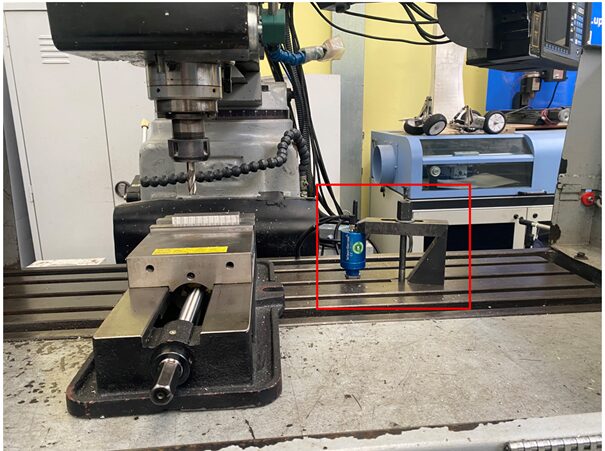
Through AI-MATTERS and the LMS team, FIZIX gained access to the LMS machining facilities, where a dedicated CNC milling testbed was customized to host the FIZIX OPro smart sensor.
Together with LMS experts, a structured Taguchi L36 Design of Experiments (DoE) was defined and executed. The testing campaign consisted of 36 machining experiments, systematically varying:
- tool geometry (diameter and number of flutes),
- workpiece material,
- feed rate, spindle speed, and depth of cut,
- and sensor positioning.
During each experiment, 68 distinct sensor signals, including vibration, acoustic emission, magnetic flux, velocity, and temperature, were recorded via the FIZIX platform. The data collected was then analysed using ANOVA-based statistical methods to evaluate:
- signal responsiveness to machining parameters, and
- the ability to differentiate normal and anomalous machining conditions such as tool breakage, overheating, and permanent tool damage.
This approach provided FIZIX with a controlled, repeatable, and independent validation framework, grounded in real industrial conditions.
The Results
The collaboration between AI-MATTERS, LMS, and FIZIX delivered clear and measurable outcomes:
- 16 out of 68 sensor signals showed statistically significant responsiveness to machining parameters
- Magnetic flux and velocity signals successfully differentiated anomalous machining conditions from normal operation
- The testing confirmed the diagnostic reliability and industrial robustness of the FIZIX OPro sensor
- FIZIX avoided an estimated €25,000 – €40,000 in equivalent external testing and validation costs
- Independent validation significantly accelerated product readiness and market adoption
The results provided strong evidence of the sensor’s capability to monitor process variability and detect early indicators of abnormal machine behavior.
Looking Ahead
Building on the results achieved through AI-MATTERS and LMS, FIZIX plans to further strengthen its AI-based analytics and expand the application of its validated monitoring technology across additional industrial use cases.
Future steps include:
- enhancing anomaly detection models using validated signal subsets,
- scaling deployments across different machine types and sectors, and
- supporting industrial clients in reducing unplanned downtime and maintenance costs through data-driven decision-making.
The collaboration has positioned FIZIX with a solid, evidence-based foundation for continued growth in industrial predictive maintenance.
Conclusion
FIZIX’s story demonstrates the transformative potential of AI in European manufacturing. By addressing challenges head-on and leveraging the resources of AI-MATTERS, they’ve paved the way for a future of smarter, more efficient operations.RS, they’ve paved the way for a future of smarter, more efficient operations.

Would you like to know how our project managers can help your organisation?
Contact us for a non-binding conversation: https://ai-matters.eu/contact/