
CEITEC Brno University of Technology is involved in predictive maintenance of machines and equipment as part of its activities in the field of artificial intelligence and high-performance computing. Thanks to a model industrial factory (testbed) and a HPC cluster NVIDIA DGX A100 / DGX H100, which is part of the TEF infrastructure, we can not only analyse data, but also measure and collect it.
One of our customers for machine time usage is the Czech company Neuron Soundware, which is one of the leading specialists in the field of predictive maintenance. Research group leader Prof. Pavel Václavek mentioned: “We have extensive experience in the diagnostics of electric drives, from vibrodiagnostics to the development and deployment of AI algorithms into industrial microcontrollers. We cooperate with clients from the manufacturing industry, either directly on specific projects or by providing them access to HPC technology to optimise their own operations.”
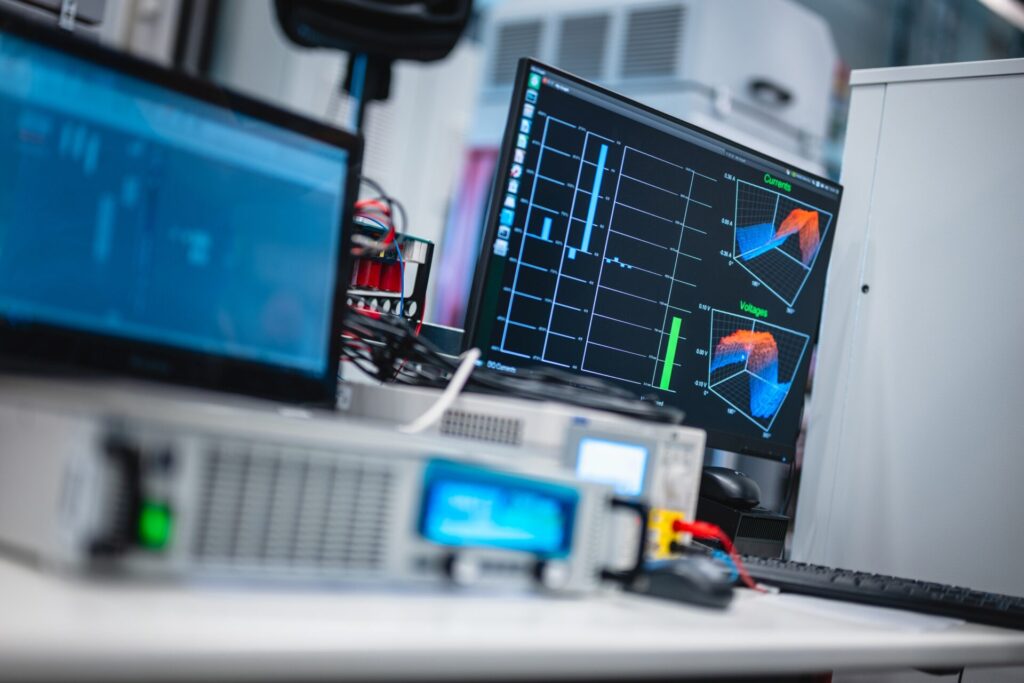
Predictive maintenance in modern industry
Predictive maintenance approaches for drives are becoming an essential component of modern operational strategies expanding across sectors such as robotics, the automotive industry, CNC technology and other industrial applications. These solutions facilitate early fault detection, condition monitoring, and subsequent control in drive systems. Permanent magnet synchronous motors (PMSM) are one of the most important types of electric drives on the market, especially in the automotive industry. One of the primal risks associated with these motors is potential for short circuits between windings, which can lead to damage or failure.
Predictive maintenance approaches for drives are becoming an essential component of modern operational strategies expanding across sectors such as robotics, the automotive industry, CNC technology and other industrial applications. These solutions facilitate early fault detection, condition monitoring, and subsequent control in drive systems. Permanent magnet synchronous motors (PMSM) are one of the most important types of electric drives on the market, especially in the automotive industry. One of the primal risks associated with these motors is potential for short circuits between windings, which can lead to damage or failure.
Methodology and implementation approach
Depending on specific needs, we use a range of diagnostic methods, incorporating both conventional algorithms and combinations of these with artificial intelligence applications. Several parameters must be considered when planning a specific methodology: the budget, time available for implementation, the need for universal solutions, the reaction after fault detection, the level of automation, etc.
Depending on specific needs, we use a range of diagnostic methods, incorporating both conventional algorithms and combinations of these with artificial intelligence applications. Several parameters must be considered when planning a specific methodology: the budget, time available for implementation, the need for universal solutions, the reaction after fault detection, the level of automation, etc.
Conditional convolutional autoencoder
One of the highly innovative methods we use is the application of a conditional convolutional autoencoder. Our team specialises in the design and development of the autoencoders with integrated fault detection algorithms, which we then integrate into the target microcontroller for use in controlling or monitoring electrical equipment. The microcontroller is able to reliably detect short circuits between windings in real time.
Alternatively, a methodology based on monitoring drive vibration data and analysing it using artificial intelligence can be used for fault detection. The advantage of this approach compared to measuring electrical quantities is its direct correlation to the mechanical condition of the drive, its speed of deployment, and its ability to detect faults at an early stage before they affect electrical parameters. Detection based on the measurement of electrical quantities can be difficult in the case of low motor speeds and a small range of faults. However, the vibrodiagnostics method requires the installation of additional sensors.
AI application method using a convolutional autoencoder
An unsupervised artificial intelligence method based on a conditional convolutional autoencoder is used to diagnose mechanical, magnetic, and electrical faults in permanent magnet synchronous motors (PMSM). This approach responds to the current trend of increasing computing power of microcontrollers, which enables advanced condition monitoring and diagnostics directly on edge devices (edge computing) without the need for external computing hardware.
The autoencoder is an encoder-decoder neural network that is trained exclusively on data representing a healthy motor state. The encoder extracts key features of the input signals (e.g., currents, voltages, vibration or magnetic quantities) and maps them to a low-dimensional latent space. This latent space represents a compressed representation of normal system behaviour adapted to the limitations of the microcontroller. The decoder then attempts to reconstruct the original input signal from this representation.
In real-world applications, the principle of fault detection is based on the evaluation of anomalies without the need for explicit knowledge of specific types of faults. The models are trained in the TensorFlow environment and then optimised directly on the target microcontroller.
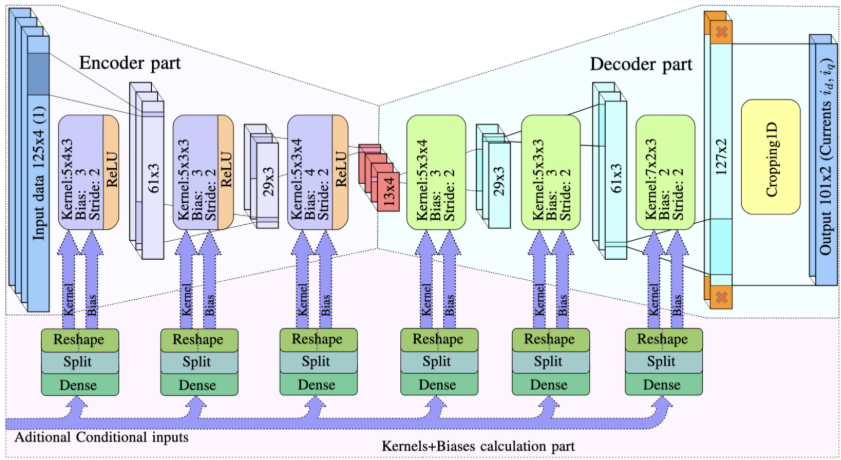
Structure of basic autoencoder
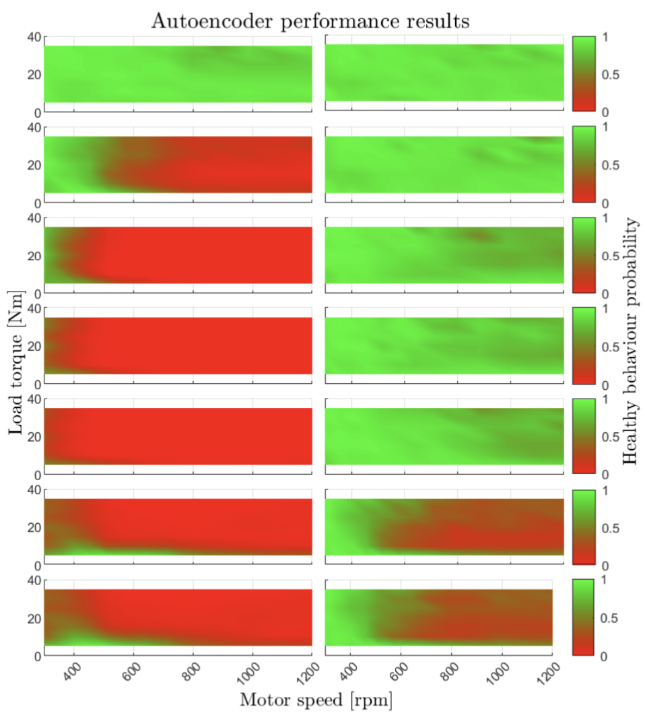
The measured inference times are short enough for real-time deployment and early fault detection before irreversible thermal damage to the motor occurs. In combination with a multi-phase motor configuration and a suitable fault operation control strategy, it is possible to ensure continued operation with reduced maximum torque. The device’s ability to remain operational even fault has been detect, enhances user safety, for example in operating electric vehicles.
Autoencoder performance results
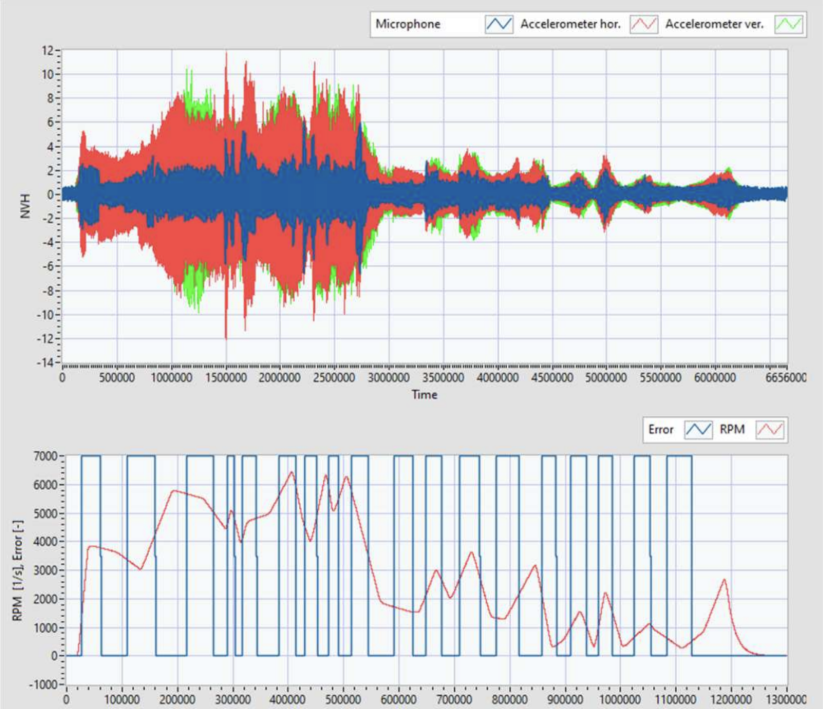
Predictive maintenance of machines and equipment using vibration diagnostics
Detecting short circuits between PMS motor windings using AI-processed vibration data can be very reliable, even when only mechanical signals (vibrations generated by a faulty motor) are measured. The collected data sets are transformed into simple 2D images.
The 2D CNN provides very reliable results for detecting PMSM faults (with an efficiency of more than 99%) from the vibration signal without any prior knowledge of the system or intensive preprocessing of the input data. Raw vibration data from the microphone and accelerometers is processed directly by a simple convolutional neural network.
The amount of measured data depends on the specific device, but large data files are usually not required and it is not necessary to spend too much time with testing, even when values for different motor operating conditions such as speed, torque, fault type, and severity are applied. One hundred test runs may be sufficient to train the neural network and validate the neural network structure. This collected data is converted into 2D images that can be easily analysed in program Keras.
Cooperation process
To discuss the possibility of cooperation, please contact us directly. The initial step is to complete the Request for Quotation form. This form is used to clarify your expectations and requirements, including the brief description of the project, the number of GPU hours required, any necessary support, and the requested timeline.
Cooperation is very similar to a standard commercial collaboration in that it involves no unnecessary delays and no additional paperwork after payment.
Next steps – process of cooperation