Keeping industrial fleets efficient, connected, and safe is a growing challenge for manufacturers and technology providers. As vehicles, equipment, materials, and people increasingly interact within the same environment, companies need smarter ways to track assets, optimize movements, and coordinate operations in real time. AI-MATTERS supports the testing and validation of AI-based fleet management solutions through a realistic industrial environment, connectivity and location technologies, intralogistics systems, simulation capabilities, and data-driven experimentation.
The Challenge
Asset tracking and fleet management become difficult when operations depend on many moving elements, changing layouts, and real-time decisions. Vehicles, equipment, and materials must be located accurately, coordinated efficiently, and managed without creating delays, conflicts, or unnecessary movements.
In practice, industrial environments are dynamic. Positioning accuracy can vary depending on the technology used. Routes may need to change because of congestion, layout constraints, or operational priorities. Navigation must remain safe and reliable even when multiple assets are moving at the same time, especially in environments where autonomous vehicles and human operators share the same space.
For AI developers and solution providers, the challenge is not only to build algorithms, but to validate them in conditions that reflect real industrial complexity. A model for route optimization or fleet coordination may perform well in simulation alone, but struggle when exposed to real connectivity, real infrastructure, human interaction, and real operational variability.
The Solution
AI-MATTERS and MADE Competence Center provide a testing and experimentation service for Assets Fleet Management, designed to support the development and validation of AI-based solutions for asset tracking, fleet coordination, and industrial operations.
The service combines a realistic industrial testing facility with selected connectivity and location technologies (e.g GPS, Wi-Fi, BLE, and UWB). This allows solution providers to assess how different technologies perform in tracking, positioning, and coordination scenarios, and to explore which combinations best support their specific use case.
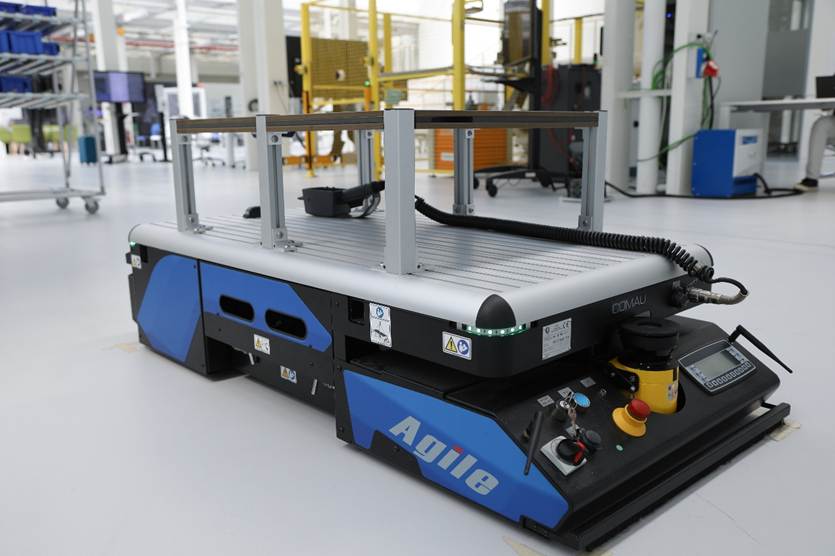
The available infrastructure includes the physical testing facility, reproducing intralogistics and production environments, AGVs, as well as tracking devices including RFID, BLE, and RTLS. This makes it possible to test not only digital models, but also the interaction between AI algorithms, physical assets, and the industrial environment in which they operate.
A key added value of the service is its simulation capability, which makes it possible to model and test the behavior of AGVs, production processes, operational areas, and production order management before or alongside physical experimentation. This allows solution providers to analyze different fleet configurations, assess routing strategies, and evaluate how assets respond to changing workloads, priorities, and plant layouts. By combining simulation with real infrastructure and real data, companies can compare scenarios, identify bottlenecks, and refine their AI models with greater speed and lower risk.
The service supports several high-value use cases. These include intelligent route optimization, where different approaches to the vehicle routing problem can be validated, from graph-based methods to machine learning techniques. It also supports automated environment navigation, enabling the development and testing of AI-based capabilities for safe and flexible movement within an industrial layout, including interaction with human operators. In addition, the service enables experimentation with distributed intelligence at fleet level, where multiple moving and static assets can be coordinated through network infrastructure and real-time data inputs.
The testing environment is further supported by software tools for implementation, route visualization, and cloud-to-edge computing for evaluating the best paths and operational strategies. Real-time datasets and historical datasets are also available, allowing solution providers to train, test, and refine their models using both live and past operational data.
How we help you
- Test AI-based fleet management solutions in a realistic industrial environment
- Evaluate asset tracking performance using GPS, Wi-Fi, BLE, UWB, RFID, and RTLS
- Validate route optimization approaches with physical assets and facility constraints
- Simulate AGVs, processes, operational areas, and production orders to compare scenarios and improve decision-making
- Develop and test autonomous navigation capabilities, including safe interaction with human operators
- Explore distributed intelligence for coordinating multiple vehicles and assets
- Use real-time and historical datasets to train, benchmark, and improve AI models
- Reduce technical risk before deployment
Ready to take the next step toward industrial deployment?
If you are developing an AI-based solution for asset tracking or fleet management, or if you are an industrial company looking to integrate smarter fleet coordination into your operations, AI-MATTERS offers a practical environment to test and validate the technology. With access to industrial infrastructure, connected assets, intralogistics systems, simulation tools, and data-driven experimentation, you can refine performance, reduce risk, and move forward with greater confidence toward industrial readiness.