Until yesterday, artificial intelligence in the factory was a silent spectator: it analyzed data, generated charts, and suggested optimizations.
Today, artificial intelligence no longer just observes: it takes action.
The Zerynth Case
Zerynth is an Italian deep-tech company that develops an IIoT platform for the rapid and scalable digitalization of industrial production. The company is currently evolving its solution into an Industrial AI Copilot platform, equipped with a conversational agent that enables natural interaction with production data and processes. The development of this artificial intelligence component is considered strategic for the evolution of the product and the company’s future positioning.
The Problem: The Technical Barrier Between Humans and Machines
Configuring an industrial monitoring system or changing production parameters often requires specific technical skills and time spent navigating complex software. This “barrier to entry” slows down operations and increases the risk of manual errors.
The challenge of our experimentation was clear: to make the factory not only reactive, but self-configurable through natural language.
The Solution: AI Agents with Actuation Capabilities
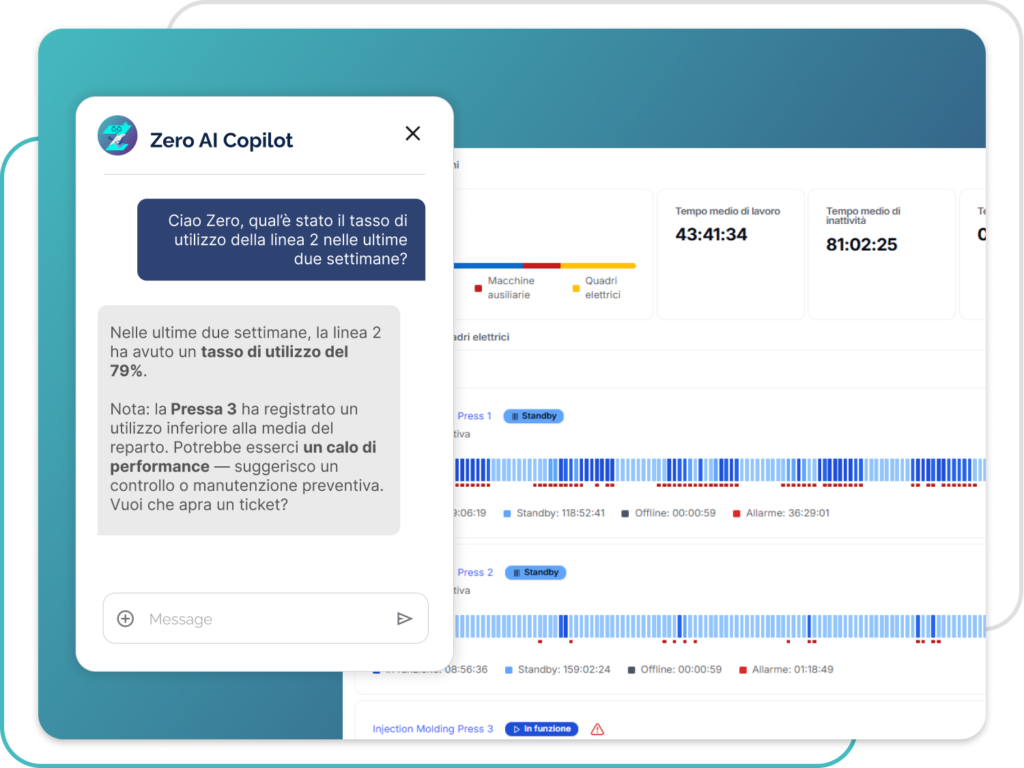
For this project, we developed a modular architecture based on Agentic AI. Unlike a standard chatbot, this system is equipped with “digital hands” (through APIs and MCP protocols) that allow it to interact directly with the Zerynth platform.
The solution is built on three technological pillars:
- Agent orchestration: Use of the Agno framework to manage specialized agents handling different tasks, from cost analysis to device configuration.
- Cloud-to-edge integration: Through Zerynth Jobs APIs, text input is translated into a physical command sent directly to the IoT gateway on the machine.
- Rules engine automation: The AI can autonomously generate alarm and automation rules, translating an operator’s request into the correct technical syntax.
Safety First: Human-in-the-Loop
Interacting with heavy machinery requires extreme caution. For this reason, the system incorporates AI Safety and Explainable AI (XAI) principles. The agent never executes a critical command autonomously: the system preconfigures the action and always requires explicit user confirmation (human-in-the-loop).
In addition, every action is accompanied by an explanation of why the system is suggesting it, significantly reducing operational risk.
What We Learned from the Tests
Validation in demo environments and at the MADE competence center produced encouraging results, but also highlighted several challenges for the future:
- Context precision: The AI performs well in understanding temporal requests (“this week”) and complex filters (“only the presses on line A”).
- Manual digitalization: Manuals rich in images require advanced preprocessing to avoid losing critical details during conversion into text for the RAG system.
- Name mapping: It is essential that the AI understands that “the large press” corresponds to the technical ID “PR-094”. This semantic mapping work is an area where we continue to invest.
Key Takeaways for the Future of Industry
The success of this phase of AI-MATTERS opens the door to a factory where:
- Efficiency is just a voice command away: Less time spent on configuration, more time dedicated to strategy.
- Technology becomes inclusive: Even personnel with limited software expertise can safely manage complex configurations.
- Interaction becomes proactive: The system does not simply wait for commands—it suggests parameter changes based on energy costs or production workloads.
The collaboration between AI-MATTERS and Zerynth shows that conversational control is the key to safe and democratic digitalization. The factory of the future will not be controlled with code, but through dialogue.y is one that can answer the questions of its operators. And today, it has finally started to do so.
Why AI-MATTERS?
AI-MATTERS enables companies to:
- Test AI solutions in real-world manufacturing enivronments
- Access advanced infrastructure and expertise
- Validate performance before scaling or investing
By bridging the gap between prototype and deployment, AI-MATTERS helps companies move from experimentation to industrial implementation with reduced risk.
FAQs
AI-driven automation in manufacturing can safely be implemented by combining AI agents with human-in-the-loop validation. This ensures that critical actions are reviewed before execution, reducing operational risk while enabling automation.
For more information and a specific dive into your use case, we welcome you to contact us for a non-binding conversation.
Validation requires testing the AI system in realistic environments using live data and real use cases. This ensures the system can handle operational complexity, integrate with existing systems, and perfrom reliably before scaling.
An AI copilot enables:
- Faster decision-making
- Reduced downtime
- Automated configuration systems
- Improved operational efficiency
By turning natural language into actions, it reduces reliance on technical expertise to accelerate repsonse times.
Natural language interfaces allow operators and engineers to interact with machine and systems more intuitively, eliminating the need for complex software navigation. This reduces errors, speeds up operations, and makes advanced technology accessible across the organization.
Explainable AI (XAI) ensures that every recommendation or answer can be traced back to its data source. This builds trust among engineers and operators and is critical for decision-making in safety-critical environments.
Would you like to know how our project managers can help your organisation?
Contact us for a non-binding conversation: https://ai-matters.eu/contact/