Introduction
In this user story, we show how CASP used AI-MATTERS to experiment with AI, validate its impact, and gain concrete results – without upfront risk. AI-MATTERS provides access to real production environments, data and expertise to test AI solutions before deployment.
Working with KLEEMANN as the industrial reference case, CASP tested an AI vision system that automatically inspects assembled electrical panels against their DXF reference files. The validated solution reached 96.4% inspection accuracy compared to manual inspection and cut inspection time from 3–4 minutes to about 10 seconds. AI-MATTERS provided the production environment, data and expertise needed to prove the solution before scaling it.
About the client
CASP is a software, consulting and robotics solution provider working with European industry, universities and technological institutes. The company had already delivered an initial AI vision-based inspection pilot to KLEEMANN and wanted to validate and mature that technology in a real industrial environment, moving it from an early prototype toward deployment-ready maturity (TRL 4–8). To do that credibly, CASP needed an independent, realistic setting in which to prove robustness, measure performance against clear KPIs, and strengthen its capacity to offer a more scalable inspection service to future customers.
The Challenge
In elevator manufacturing, each electrical panel is highly customised: relays, fuses, rails, electrical boards and batteries are mounted on a backplate according to a product-specific DXF design file. Today, the final quality check is performed manually by a skilled supervisor at the last workstation of the assembly line, and it takes roughly 3-4 minutes per panel. This created several open problems for KLEEMANN:
- Manual inspection was slow and depended on the availability and attention of a high-skilled operator.
- Defects detected late in the line, was forcing panels to be transported back to an earlier workstation, increasing cycle time and rework effort.
- CASP’s existing inspection service worked as a pilot, but its accuracy, latency and ability to reconfigure to new panel designs had not been independently measured against industrial KPIs.
CASP could not fully resolve this internally because it lacked an independent, realistic production environment, the representative data, and the structured KPI-based evaluation needed to prove the solution before recommending investment.d deliver measurable accuracy and throughput improvements before committing to full-scale deployment.
The Approach
Through AI-MATTERS, CASP gained access to the resources required to test, experiment with and validate its inspection service in a real setting:
- Real-world production environment: KLEEMANN’s electronics plant in Kilkis, Greece, where electrical panels for lift control systems are assembled.
- Relevant data and use cases: KLEEMANN provided production requirements, .DXF design files, representative assembly scenarios, inspection criteria and validation feedback.
- Expert support: LMS acted as the evaluation and technical validation partner, preparing a KLEEMANN-inspired dataset, designing the experiments, running the test environment and measuring KPI performance.
The collaboration focused on testing and validating the solution through experimentation, enabling the company to assess feasibility and impact before deployment.
Each partner played a clear role: CASP as the service owner and integrator, LMS as the independent evaluator and technical validator, and KLEEMANN as the industrial end user providing the reference case and validation input. The collaboration focused on testing and validating the solution through structured experimentation — letting CASP assess feasibility and impact before any wider deployment.
What has been tested?
The Technology
An AI-based vision pipeline for elevator panels’ inspection.
The Use case
Automated quality inspection of assembled electrical panels for elevators: verifying component completeness, type and placement before a panel leaves its workstation, and visually guiding operators on any corrective actions.
Experiment setup
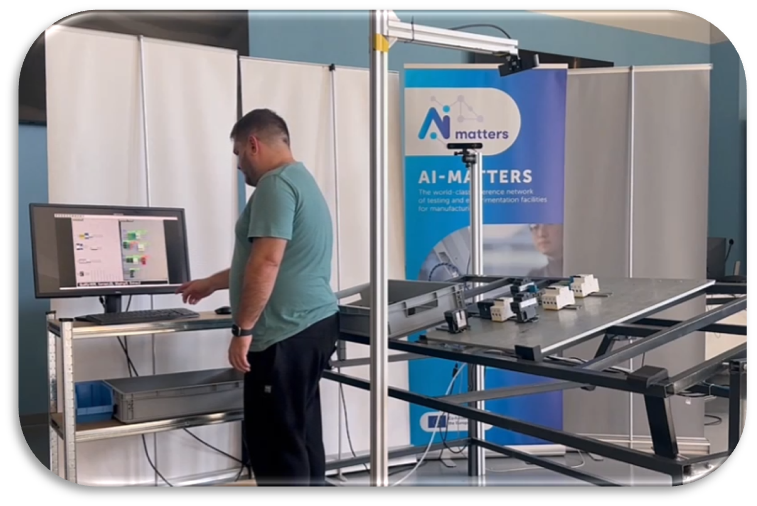
Tested directly on KLEEMANN’s shopfloor with minimal changes to existing infrastructure. A ZED 2i stereo camera was mounted on a custom rotating base matching the workstation’s tilt, with no special lighting, to maximise adaptability. Realistic panels were assembled from genuine KLEEMANN components and captured at various levels of completeness, then processed by the full pipeline and compared with manual inspection results.
The Impact
The experiment delivered strong, measurable outcomes:
- 96.4% inspection accuracy compared to manual inspection across twenty runs on four panel designs.
- Inspection time cut from 3-4 minutes to about 10 seconds per panel, dramatically reducing assembly-line cycle time.
- 100% automation of the inspection step, with the operator only triggering the run.
All industrial and technical KPI targets were met or exceeded, including a 100% true-positive detection rate and 99% overall component-detection accuracy.
Industrial KPIs
| KPI | Target | Achieved |
|---|---|---|
| Duration of inspection time | ≤30 sec | 10 sec |
| Deviation from manual inspection reference | ≤5% | 3.6% |
| Automated quality inspection process | 100% | 100% |
| True positive detection rate (TPR) | ≥95% | 100% |
| False positive rate (FPR) | ≤15% | 12.8% |
| Segmentation model latency | ≤5 sec | 1 sec |
| Detection model latency | ≤5 sec | 1 sec |
| Overall components detected | ≥95% | 99% |
CASP received a proof-of-concept validation report with full test results and a feasibility assessment, enabling informed decisions about further development and deployment.
Key Insights
- What worked. The AI models generalized well under realistic industrial conditions, reaching near-0.99 precision and recall, and the system ran fast enough for real production use. Comparing detected components directly against the DXF design proved a robust, transparent way to score quality and guide operators.
- What was harder. In three of the twenty test cases the system slightly over-counted missing or extra components, nudging the false-positive rate up to 12.8% — still within target, but a clear area to refine. A standard camera sensor and ambient lighting were enough to validate the concept, but this can be further enhanced for continuous 24/7 use.
- What they would do differently. Collected recommendation were focused on moving to industrial-grade cameras for stability and reliability, and retraining the AI models on larger, more varied datasets and lighting conditions.
What’s next?
CASP, KLEEMANN and LMS plan to extend validation with more KLEEMANN-specific datasets and additional .DXF configurations to further strengthen robustness and explainability for non-expert users. The roadmap includes hardening the solution for continuous industrial use, enhancing model adaptability to new products, and adding monitoring, reporting and usability features for large-scale adoption. KLEEMANN indicated a likely follow-up investment in the AI inspection tool within twelve months, progressing from pilot to an extended pilot.
Why AI-MATTERS?
AI-MATTERS enables companies to:
- Test AI solutions in real production environments
- Access data, expertise and infrastructure
- Validate impact before investing
Through collaborative experimentation, companies can move from idea to validated solution with reduced risk and uncertainty.
FAQs
“AI-enabled visual inspection of electrical cabinets for elevator manufacturing” — an AI computer-vision service that checks assembled panels against their CAD design.
Through AI-MATTERS you can run a structured experiment in a real production environment using your own or representative industrial data, with expert partners measuring performance against agreed KPIs, so you see concrete results and a feasibility assessment before committing to a full investment.
For more information and a specific dive into your use case, we welcome you to contact us for a non-binding conversation.
In this validation it reached 96.4% accuracy compared with manual inspection, with a 100% true-positive detection rate and 99% overall component-detection accuracy.
About the Authors
Apostolis Papavasileiou, Project Manager, LMS representative
CASP representatvie
Teaching Factory Competence Centre (TF-CC) — Laboratory for Manufacturing Systems & Automation (LMS), University of Patras. The TF-CC team specialises in the co-design, validation, and deployment support of digital and AI solutions for industrial process automation, quality management, and operational decision-making. AI-MATTERS activities at LMS include KPI-based evaluation, experimental protocol design, and the packaging of validated methods into repeatable service offerings for manufacturing companies.



Would you like to know how our project managers can help your organisation?
Contact us for a non-binding conversation: https://ai-matters.eu/contact/