What is Accelerated Design of Electrical Machines using AI-Supported Optimization and how does it help you design better actuators, faster?
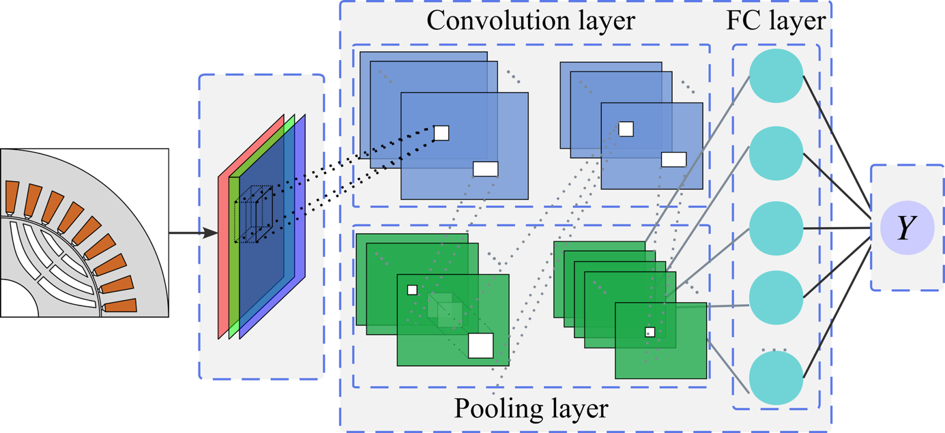
“Accelerated Design of Electrical Machines using AI-Supported Optimization” enables companies to optimize electric actuators which don’t rely on rare earth materials, using AI-based surrogate models instead of time- and resource-intensive FEA simulations. It helps reduce design time, lower computational cost, and deliver validated, ready-to-use results, whether you need an optimized actuator design or the know-how to run this kind of optimization yourself.
What does this service entail?
“Accelerated Design of Electrical Machines using AI-Supported Optimization” is a service that supports companies in designing and optimizing electric actuators that do not require rare earth materials, using AI-based surrogate models replacing classical, computationally expensive FEA simulations.
It is designed for:
- Manufacturers of electric machines and actuators
- Innovation leaders, R&D teams, and CTOs looking to reduce dependency on critical raw materials
- Engineering teams that want to learn how to apply AI surrogate modelling in their own design processes
The service focuses on enabling organizations to optimize electric actuator designs faster and at lower cost, either by having IEW run the optimization directly, or by transferring the methodology so companies can apply it themselves.
Why is the service important?
Many companies developing electric actuators and machines face the same set of challenges:
- Rare earth materials (e.g. for permanent magnets) carry supply risk, price volatility, and geopolitical dependency
- Classical FEA-based design optimization is time consuming and computationally expensive, limiting how many design variants can realistically be explored
- Few engineering teams have in-house expertise in AI-based surrogate modelling for electromagnetic design
Without faster, more flexible optimization methods, companies risk longer development cycles, higher engineering costs, and continued dependency on critical raw materials — even when rare-earth-free alternatives are technically feasible.
How does the service work?
The service typically follows these steps:
- Define the actuator requirements and objectives: performance targets, geometry constraints, application context
- Identify relevant topologies, design parameters and materials
- Set up or train the AI surrogate model: using existing FEA data or generating new training data where needed
- Run optimizations: exploring the design space quickly using the surrogate model instead of full FEA simulations
- Evaluate results and validate feasibility: comparing surrogate predictions against FEA or measured reference data
- Provide recommendations for next steps: an optimized actuator design, and/or guidance on applying surrogate-based AI optimization internally
What are the benefits?
- Faster development cycles: explore many design variants in a fraction of the time required by FEA-only workflows
- Lower computational and engineering cost: surrogate models replace repeated, expensive simulations
- No dependency on rare earth materials: designs are optimized rare-earth-free topologies
- Validated results: outcomes are checked against FEA or measurement data, not just AI predictions
- Knowledge transfer: companies can choose to receive an optimized design, learn the method, or both
- Scalability: once trained, surrogate models can be reused across multiple design variants and future projects
When should you use this service?
This service is most relevant when:
- You are developing or redesigning an electric actuator and want to avoid rare earth materials
- Your current FEA-based optimization process is too slow or too costly to explore enough design alternatives
- You want to evaluate many design variants quickly before committing to detailed engineering
- You want to build internal capability in AI-based surrogate modelling for electromagnetic design
Key Insights
Based on testing and experimentation, companies often learn that:
- A well-defined surrogate model can significantly accelerate the optimization process, compared to time-consuming FEA simulations
- Validation against real FEA or measurement data is essential. Surrogate predictions should always be checked against physical reality
- Depending on the application, rare-earth-free actuators can fully replace conventional machines that use permanent magnets
Why AI-MATTERS?
AI-MATTERS provides:
- Access to real production environments
- Data and use cases for experimentation
- Expert support throughout the process
This allows companies to move from idea to validated solution with reduced risk.m experimentation to validated industrial AI solutions with reduced risk and increased confidence.
FAQs
Depending on the scope of the desired optimization, the service typically takes 2 to 12 months.
The service includes defining your actuator requirements and design goals, setting up or training an AI surrogate model tailored to your use case, running optimization experiments across the design space, and validating the results against FEA or measurement data. At the end, you receive concrete recommendations — either an optimized actuator design, hands-on guidance for applying the method yourselves, or both.
Interested in testing or validating AI in your production environment?
Explore how AI-MATTERS can support your use case by leaving your contact information below. Our expert team will help you define your use case and design a validation experiment tailored to your production context
👉 https://ai-matters.eu/contact/