What is Dynamic Robot Task Planning & Resource Orchestration and how does it help you test AI before investing?
Dynamic Robot Task Planning & Resource Orchestration enables companies to test and validate AI solutions in real production environments before full deployment. It helps reduce risk, assess feasibility, and generate concrete results through experimentation with real data and use cases.
What does this service entail?
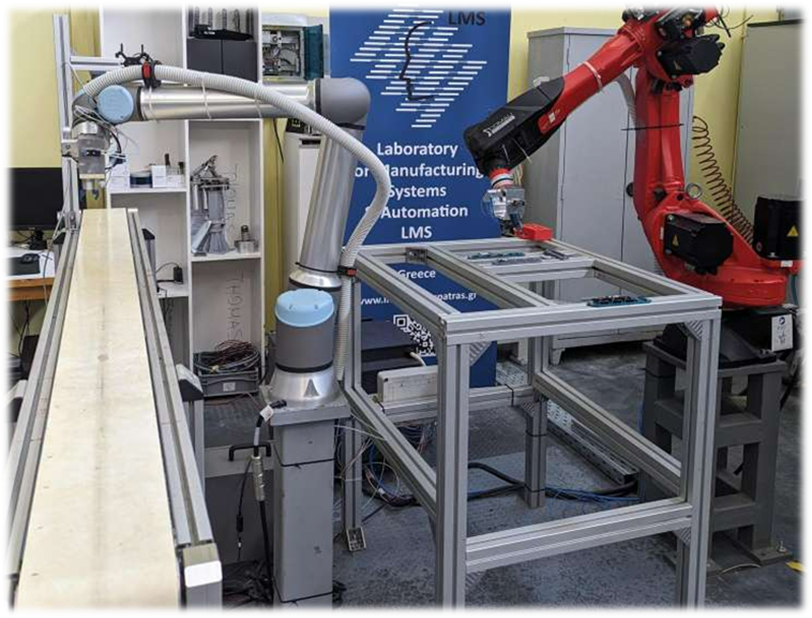
Dynamic Robot Task Planning & Resource Orchestration enables manufacturers to test and validate AI-driven coordination of multiple robots in realistic production environments before deployment. The service helps companies reduce implementation risk, improve flexibility, validate performance and generate evidence-based results using real industrial scenarios.
This service supports companies in testing, validating and improving AI solutions for multi-robot coordination, task allocation and motion planning. It is designed for SMEs, innovation leaders, robotics developers and technology providers that need to validate AI systems before commercial deployment.
The service focuses on evaluating performance, reliability, safety and scalability in realistic industrial environments.
Why is the service important?
Many manufacturers struggle to adopt advanced robotics because:
- Testing AI solutions in real production environments is expensive.
- Multi-robot coordination introduces safety and reliability challenges.
- Return on investment is uncertain without industrial validation.
- Building dedicated testing infrastructure requires significant resources.
Without proper validation, AI projects may face delays, unexpected costs and limited industrial adoption.
How does the service work?
The service typically follows these steps:
- Define the industrial use case and validation objectives.
- Select a representative production scenario.
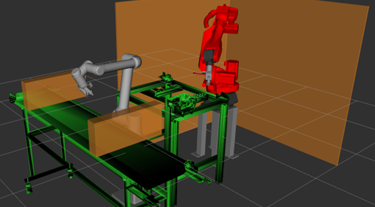
- Configure the robotic cell, sensors and digital twin environment.
- Integrate the AI module into the testing infrastructure.
- Execute industrial experiments under realistic operating conditions.
- Measure technical and industrial KPIs.
- Evaluate performance, safety, reliability and adaptability.
- Provide recommendations for deployment and future development.
What are the benefits?
The experiment resulted in all five industrial KPIs and all five technical KPIs being met or exceeded:
| For SMEs | For innovators and system integrators | For technology providers |
|---|---|---|
| Validate multi-robot solutions without investing in costly robotic infrastructure | Evaluate AI-driven task planning and resource orchestration under realistic production conditions | Demonstrate technology maturity in industrial environments |
| Reduce validation costs by accessing robots, sensors and digital twins. | Quantify improvements in resource utilization, flexibility and reconfiguration time | Validate AI algorithms for motion planning, task allocation and collision avoidance |
| Test different production variants before commercial deployment | Assess system reliability, adaptability and scalability before deployment | Increase technology readiness level (TRL) through industrial testing |
When should you use this service?
This service is most relevant:
- When you want to validate AI before investing.
- When you need to test multi-robot coordination.
- When you are moving from prototype to industrial deployment.
- When you require evidence to support commercialisation decisions.
- When you need to assess safety, reliability and scalability.
Example use cases
CASP is a software company based in Athens specializing in production planning, scheduling, robotics, supply chain management and virtual reality applications. CASP developed an AI-driven module for dynamic robot task planning and resource orchestration capable of coordinating multiple robots, assigning tasks dynamically and generating collision-free trajectories using sensor data and digital twins.
Through AI-MATTERS, CASP validated the solution in a realistic multi-robot assembly environment. The testing included robot coordination, dynamic task allocation, collision avoidance and real-time motion planning under changing production conditions.
Achieved results:
- Reconfiguration time reduced from 1–2 months to 5.5 hours for minor changes.
- Full system reconfiguration reduced to only a few days.
- Digital twin-based module reconfiguration completed in 29 minutes.
- Resource utilization reached 85%.
- Collision avoidance achieved 100% success.
- Motion planning accuracy reached 96%.
- System uptime reached 100%.
- Solution maturity increased from TRL 3 to TRL 7.
Read the full use case with CASP & KLEEMANN here.
Key Insights
- Real-world testing is essential for validating industrial AI.
- Digital twins significantly reduce reconfiguration effort.
- Multi-robot coordination can substantially improve resource utilisation.
- AI-driven motion planning can achieve high accuracy and safety when validated in realistic environments.
- Access to specialised infrastructure accelerates industrial adoption.
Why AI-MATTERS?
AI-MATTERS can provide:
- Access to industrial robots, sensors and digital twin technologies.
- A realistic production environment for testing.
- Robotics and AI expertise from LMS.
- Structured KPI-based validation methodologies.
- Support for trustworthy AI assessment and regulatory readiness.
This enables companies to validate its solution without investing a lot in independent testing infrastructure.
FAQs
Dynamic robot task planning & resources orchestration by our partner LMS.
The service helps manufacturers and technology providers address challenges related to:
- Multi-robot coordination
- Dynamic task allocation
- Production flexibility
- Fast reconfiguration of robotic cells
- Collision avoidance
- Real-time adaptation to changing production requirements
The solution is integrated into a realistic production environment equipped with industrial robots, sensors and digital twin technologies. The AI system is tested against industrial and technical KPIs, including resource utilization, reconfiguration time, motion planning accuracy, collision avoidance and system reliability.
Companies can:
- Reduce validation costs and risks
- Accelerate time-to-market
- Improve production flexibility
- Validate AI performance before commercial deployment
- Increase technology readiness levels (TRLs)
- Generate industrial proof-of-concept results supported by measurable KPIs
Interested in testing or validating AI in your production environment?
Explore how AI-MATTERS can support your use case by leaving your contact information below. Our expert team will help you define your use case and design a validation experiment tailored to your production context
👉 https://ai-matters.eu/contact/