What are Humanoid Robotics Expert Services?
Evaluate humanoid robotics for industrial use through AI-MATTERS at CIIRC CTU. Test AI capabilities, validate feasibility, and reduce deployment risks before investing.
Test the Future of Industrial Humanoid Robotics Before You Invest. CTU’s Humanoid Robotics Expert Service provided helps SMEs to integrate the multipurpose robots into their manufacturing processes
Humanoid robots have the potential to transform manufacturing, but most industrial applications still require significant technological validation before deployment. Through AI-MATTERS, the Czech Institute of Informatics, Robotics and Cybernetics (CIIRC CTU) helps companies evaluate humanoid robotics in realistic manufacturing conditions, validate key AI technologies, and understand where humanoids can bring real value—and where conventional automation remains the better choice.
What does this service entail?
The Humanoid Robotics Expert Service enables companies to explore, validate and experimentally assess the future use of humanoid robots in manufacturing and logistics before committing to major investments. Rather than offering turnkey deployment, the service focuses on testing the enabling technologies that determine whether humanoid robots can successfully perform industrial tasks.
The service is provided by the Czech Institute of Informatics, Robotics and Cybernetics (CIIRC CTU) within the RICAIP Testbed Prague, one of Europe’s leading Testing and Experimentation Facilities for AI-driven manufacturing. It is supported by the newly established Interdisciplinary Center for Humanoid Robotics (ICHR), which combines expertise in artificial intelligence, robotics, computer vision, manipulation, digital twins, human-robot interaction and industrial systems integration.
Unlike conventional industrial robots, humanoids are expected to work in environments originally designed for people. This creates new challenges in perception, locomotion, manipulation, decision-making and safe interaction with human operators. Our service helps companies evaluate these challenges under realistic industrial conditions.
Typical industrial scenarios currently investigated within the service include:
- Human-oriented machine tending using equipment designed for human operators
- AI-guided manipulation of objects with varying shapes and positions
- Material handling between workstations in flexible manufacturing
- Human-robot collaboration during assembly and logistics operations
- Vision-guided inspection and quality control
- Operation in dynamic environments with changing layouts
- Mobile manipulation combining navigation and object handling
- Human-aware navigation and safe interaction with workers
- Learning industrial skills through teleoperation and demonstration
- Validation of robotic behaviour using simulation and digital twins before physical testing
These activities are evaluated as experimental validation scenarios designed to assess technological readiness and identify future deployment opportunities rather than as fully commercial production solutions.
Why is the service important?
Industrial companies increasingly recognise the potential of humanoid robots to perform tasks that are difficult to automate using conventional robotic systems. Unlike traditional industrial robots, however, humanoids must operate safely in dynamic environments shared with people, use tools and equipment originally designed for humans, and continuously adapt to changing conditions.
This requires advanced AI capabilities that extend far beyond robot programming. Reliable perception, multimodal sensing, dexterous manipulation, whole-body motion planning, autonomous decision-making and human-aware behaviour remain active research and engineering challenges.
Without realistic validation, companies face considerable uncertainty regarding technical feasibility, integration complexity and future return on investment.
The AI-MATTERS Humanoid Robotics Expert Service reduces these uncertainties by allowing companies to test promising application scenarios using advanced humanoid platforms, digital twins and AI technologies available at the RICAIP Testbed Prague. Together with experts from ICHR, companies gain objective evidence about the technological readiness of their intended application, identify critical bottlenecks and define realistic development pathways before making significant investment decisions.
How does the service work?
Define the Industrial Challenge
Together with the customer, we identify a manufacturing or logistics process where humanoid robotics could provide added value. The objective is not simply to replace existing automation but to evaluate whether humanoid capabilities offer a meaningful advantage for a specific application.
Identify Critical AI Technologies
Our experts analyse which AI technologies are essential for the selected scenario. Depending on the application, including computer vision, multimodal perception, Vision-Language-Action (VLA) models, whole-body control, manipulation planning, learning from demonstration and digital twins.
Configure the Testing Environment
The application scenario is prepared using the facilities of the RICAIP Testbed Prague at CIIRC CTU, where industrial demonstrators, digital twins and simulation environments are combined with physical humanoid platforms to create realistic testing conditions.
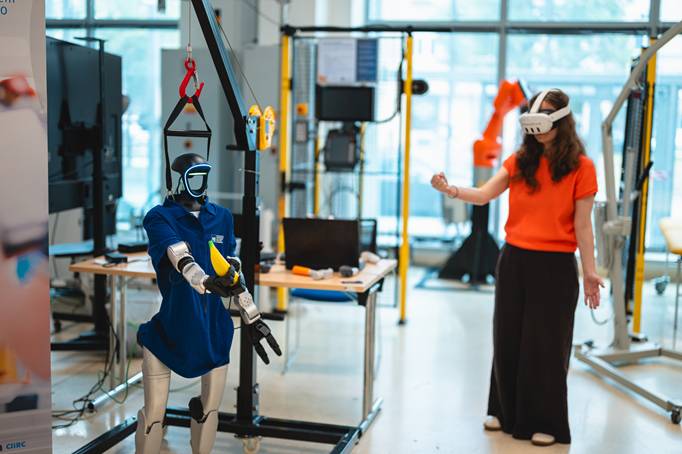
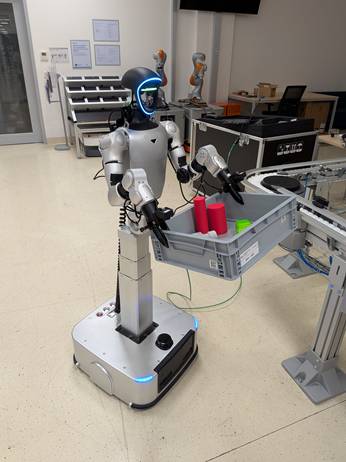
The Interdisciplinary Center for Humanoid Robotics (ICHR) operates a dedicated fleet of three advanced humanoid robotic platforms available within the AI-MATTERS framework:
- two full-body legged humanoids, equipped for locomotion, manipulation and whole-body control experiments, with the possibility of overhead crane suspension to safely develop and validate balance control, locomotion and manipulation algorithms during the early stages of testing;
- one mobile humanoid platform on a wheeled base, designed for research into mobile manipulation, autonomous navigation, intralogistics and human-robot collaboration in industrial environments.
This combination of robotic platforms enables companies to evaluate different application concepts, compare locomotion strategies and safely validate AI algorithms under realistic conditions before progressing towards pilot industrial deployments.
Perform Experimental Validation
The selected humanoid platform is used to execute representative industrial tasks while experts evaluate performance, robustness, safety and technological limitations. Depending on the maturity of the application, experiments may be conducted in simulation, on suspended legged platforms for the safe validation of locomotion and manipulation, or on fully mobile systems operating within realistic industrial demonstrators. Testing focuses on validating AI capabilities under representative industrial conditions rather than demonstrating ideal laboratory performance.
Analyse Results and Recommend Next Steps
The collected data are analysed to assess technological readiness, identify integration challenges and estimate the engineering effort required for future deployment. Companies receive practical recommendations on improving AI models, adapting application scenarios or selecting alternative automation strategies where appropriate.
Make Evidence-Based Investment Decisions
Based on the validation results, companies gain a realistic understanding of both the opportunities and current limitations of humanoid robotics for their application. This significantly reduces technological and investment risks and provides a solid basis for future R&D activities, pilot projects or industrial deployment.
What are the benefits?
The experiment resulted in all five industrial KPIs and all five technical KPIs being met or exceeded:
| For SMEs | For innovators and tech leads | For AI and Robotics technology providers |
|---|---|---|
| Explore whether humanoid robotics is a realistic solution for your manufacturing challenge before investing in expensive development or equipment. | Build a realistic technology roadmap for introducing humanoid robotics into production, supported by experimental evidence rather than assumptions. | Validate new AI algorithms, perception systems and robotic capabilities on advanced humanoid platforms operating in industrially relevant environments. |
| Compare humanoid robotics with conventional industrial automation and identify where each approach provides the greatest value. | Better understand the engineering effort, integration complexity and organisational changes required for future deployment. | Benchmark AI components such as perception, manipulation, navigation or task planning under realistic operating conditions. |
| Reduce technological and investment risks through expert evaluation and testing within the RICAIP Testbed Prague. | Use digital twins, simulation and physical experimentation to assess technological readiness before launching internal innovation projects. | Demonstrate technology maturity to customers, investors and partners using objective testing results from an independent Testing and Experimentation Facility. |
| Receive practical recommendations for future development rather than investing in unsuitable solutions. | Identify technical bottlenecks early and prioritise further development activities where they create the greatest impact. | Reduce development risk by identifying limitations and integration challenges before commercial deployment. |
When should you use this service?
This service is intended for companies that are considering whether humanoid robotics could become part of their future manufacturing or logistics operations but need objective evidence before making strategic investment decisions.
Typical situations include:
- evaluating whether humanoid robots can perform tasks that are currently difficult to automate using conventional industrial robots;
- assessing the feasibility of human-centred manufacturing scenarios where flexibility and mobility are required;
- validating AI-based perception, manipulation or navigation technologies before integrating them into robotic systems;
- comparing different technological approaches using simulation, digital twins and physical experimentation;
- preparing research, innovation or pilot projects that require a realistic assessment of the current technological readiness of humanoid robotics.
Rather than delivering a complete production solution, the service helps companies understand what is already possible today, what still requires further development, and which technological pathway is most appropriate for their specific application.
Example use cases
- Machine Tending in Human-Oriented Workspaces – evaluating whether humanoid robots can safely operate machine tools and equipment originally designed for human operators.
- AI-Based Manipulation of Unknown Objects – validating perception, grasp planning and manipulation strategies for handling objects with varying geometry, position and orientation.
- Mobile Manipulation in Flexible Manufacturing – combining autonomous navigation with manipulation to transport materials and perform operations across multiple workstations.
- Human–Robot Collaboration – evaluating safe interaction between humanoids and human workers during shared assembly or logistics tasks.
- Digital Twin Validation – testing robotic behaviours first in simulation before transferring validated AI models to physical humanoid platforms.
- Learning from Demonstration and Teleoperation – developing robotic skills by recording and transferring human demonstrations into AI-based control systems.
- Industrial AI Benchmarking – comparing perception, navigation and manipulation algorithms under repeatable experimental conditions using advanced humanoid robotic platforms.
- Technology Readiness Assessment – identifying the current maturity, limitations and future development priorities of humanoid applications before initiating pilot deployment.
Key Insights
Industrial deployment of humanoid robots depends on much more than the robotic platform itself. Success is determined by the integration of advanced perception, AI-driven decision-making, manipulation, locomotion, safety, human–robot interaction and system integration within realistic manufacturing environments.
The AI-MATTERS Humanoid Robotics Expert Service enables companies to evaluate these enabling technologies before committing to major investments. In many cases, the outcome is not simply confirmation that a humanoid robot can perform a task, but a deeper understanding of the technical barriers that remain, the engineering effort required, and the most appropriate roadmap towards future deployment.
This evidence-based approach significantly reduces technological uncertainty and helps companies make informed innovation decisions.
Why AI-MATTERS?
AI-MATTERS provides real production-like environment with diverse humanoid types which together with expertise behind creates a unique offer at the EU market.
The service is delivered by the Czech Institute of Informatics, Robotics and Cybernetics (CIIRC CTU) within the RICAIP Testbed Prague, one of Europe’s leading Testing and Experimentation Facilities for Artificial Intelligence in manufacturing.
It is backed by the expertise of the Interdisciplinary Center for Humanoid Robotics (ICHR), which brings together specialists in artificial intelligence, robotics, computer vision, industrial automation, digital twins, human-centred design and responsible deployment of autonomous systems.
Unlike conventional robot integration services, AI-MATTERS provides an independent environment where companies can experiment, validate and benchmark humanoid robotics technologies before making substantial investments. By combining advanced research infrastructure, industrial demonstrators and multidisciplinary expertise, CIIRC CTU helps bridge the gap between promising research and practical industrial innovation.
FAQs
No. Companies can use the humanoid robotic platforms, experimental facilities and expert support available at the RICAIP Testbed Prague without purchasing their own hardware.
No. The service focuses on experimental validation, feasibility assessment and technology benchmarking. Its objective is to help companies understand where humanoid robotics can create value, what technical challenges remain and what additional development may be required before industrial deployment.
Depending on the application, experiments may include computer vision, multimodal perception, object recognition, manipulation planning, navigation, learning from demonstration, human-robot interaction, AI-based task planning and digital twin validation.
Experiments are carried out using industrial demonstrators, simulation environments, digital twins and physical humanoid robotic platforms available at the RICAIP Testbed Prague, allowing companies to evaluate technologies under conditions that closely resemble real manufacturing environments.
Companies receive a technical assessment of the evaluated application, including performance observations, identified limitations, recommendations for further development and an evidence-based evaluation of the technology’s current readiness for future industrial deployment.
Interested in testing or validating AI in your production environment?
Contact the AI-MATTERS team at CIIRC CTU to discuss your application scenario. Together, we will help you evaluate the technological readiness of humanoid robotics, validate key AI capabilities and define the most effective pathway from experimental research towards future industrial deployment.
👉 https://cz.ai-matters.eu/contact/