
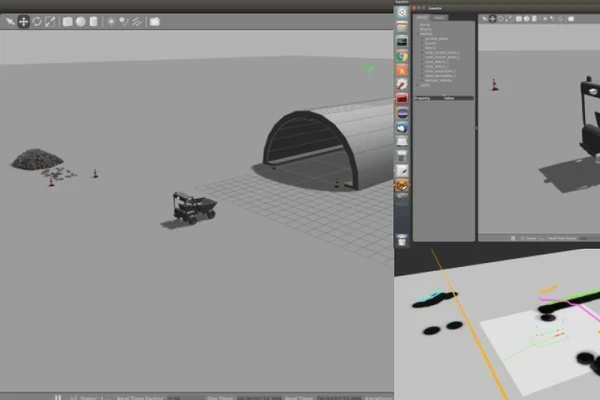
This service evaluates and benchmarks advanced AI-based algorithms for autonomous navigation, enabling companies to improve reliability, safety, and efficiency in robotic and autonomous systems. It supports developers in selecting, validating, and optimising navigation strategies before real-world deployment.
The service assesses algorithm performance using structured test batteries and measurable indicators such as navigation accuracy, obstacle avoidance success rate, trajectory efficiency, response time, and robustness under dynamic conditions. This allows companies to identify strengths, limitations, and improvement opportunities in their solutions.
Two evaluation approaches are considered:
The service follows a structured process:
The result is a detailed technical report describing algorithm performance based on predefined indicators, including quantitative metrics and benchmarking results. Outcomes may include improvements in navigation accuracy, reduction in collision rates, optimisation of path planning, and enhanced system robustness.
Typical applications include autonomous mobile robots (AMRs) in logistics, automated guided vehicles (AGVs) in industrial environments, service robots, and autonomous inspection systems. For example, robotics developers can improve navigation performance in warehouse environments, while technology providers can validate new perception and planning algorithms before integration.
To carry out the service, customers are expected to provide access to their navigation algorithms, system interfaces (e.g. control software, sensor configurations), and, where applicable, robotic platforms or representative datasets. ITA provides testing infrastructure, simulation environments, and expertise in robotics, AI, and autonomous systems.
This service is designed for:
To start a project, companies can contact ITA to define the use case, available resources, and evaluation scope. This initial step includes a feasibility assessment and KPI definition, followed by a tailored proposal, testing phase, and delivery of results.