
How can manufacturers validate AI-based robotic perception before investing in industrial automation?
In this user story, we show how Ebroacero used AI-MATTERS to test and validate advanced 3D perception technologies for robotic cutting automation in steel casting manufacturing. Through experimentation in a realistic laboratory environment, the company evaluated technical feasibility, reduced implementation risks, and established a roadmap towards industrial deployment.
As an industrial manufacturing company committed to innovation, Ebroacero needed to validate an AI-enabled robotic perception solution before investing in a full-scale automated cutting cell.
The challenge was to identify the most suitable sensing technologies, assess technical feasibility, and ensure future integration with robotic systems while minimizing development risks.
The Challenge
Ebroacero manufactures steel cast components that require the removal of risers and feeding channels through cutting operations. These processes involve complex geometries and require high precision to ensure product quality and process efficiency.
The company sought to automate this operation using robotic systems capable of identifying cutting planes directly from CAD3D models. However, several uncertainties remained:
- Which 3D perception technology would provide sufficient accuracy and robustness?
- Could point clouds generated from cast steel parts be reliably aligned with CAD3D models?
- Would the solution be viable under industrial conditions?
- How could technical risks be reduced before investing in a complete robotic cell?
Ebroacero lacked a suitable environment and specialized expertise to independently evaluate the different technological alternatives and validate the concept.
The Approach
Through AI-MATTERS, Ebroacero collaborated with the Instituto Tecnológico de Aragón (ITA) to test and validate perception technologies for robotic manufacturing applications.
The project combined:
- Access to robotic laboratories and testing facilities
- Advanced 3D vision and perception systems
- Expert support in robotics, machine vision and data processing
- Experimental validation in a realistic laboratory environment
The work was carried out over a 16-week period and focused on three main phases:
- Evaluation and selection of 3D perception technologies.
- Development of a laboratory demonstrator to validate point cloud acquisition, CAD alignment and cutting plane identification.
- Integration into a robotic cell to validate full functionality.
This experimentation-first approach allowed Ebroacero to assess technical feasibility before committing to industrial implementation.
What has been tested?
The Technology
The project evaluated advanced 3D perception technologies and robotics, including:
- Fixed 3D vision technologies
- Manual scanning technologies
- Point cloud processing and alignment algorithms
- Robotics integration
The Use case
Automated identification of cutting planes in cast steel components for future robotic cutting operations and integration into robot control.
Experiment setup
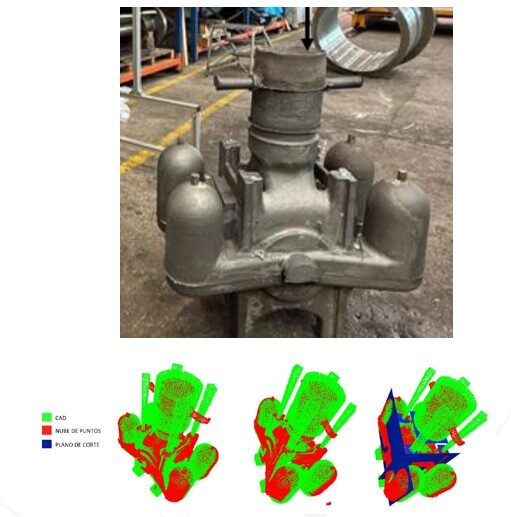
A laboratory-scale demonstrator was developed using representative cast parts supplied by Ebroacero.
The demonstrator included:
- Acquisition of 3D point clouds from real components
- Pre-processing and reconstruction of geometric information
- Alignment between captured point clouds and CAD3D models
- Identification of cutting points and cutting planes defined in the CAD model
- Transfer of information to a robotic cell
The objective was not to develop a production-ready system but to validate the technological approach and identify future industrialization requirements.
The Impact
The experiment resulted in:
- Validation of multiple 3D perception technologies for cast steel applications
- Identification of the most promising sensing alternatives for future deployment
- Successful demonstration of point cloud acquisition and CAD3D alignment workflows
- Validation of the feasibility of automatically identifying cutting planes using perception technologies
- Initial software developments for 3D data processing and geometric comparison
- Integration into robot control
Ebroacero received a comprehensive technical assessment, demonstrator results, and recommendations regarding perception technologies, hardware requirements, software architecture, integration considerations, reliability, and expected performance.
Most importantly, the company significantly reduced technical uncertainty and implementation risks before proceeding to the next phase of automation.
Key Insights
What worked?
- Combining 3D perception with CAD-based comparison proved technically feasible.
- Laboratory testing enabled objective evaluation of alternative technologies.
- Early validation helped identify practical integration requirements for future robotic systems.
What challenges were identified?
- Cast steel components present demanding surface conditions for 3D sensing.
- Data quality and acquisition strategies have a significant impact on downstream processing performance.
- Industrial deployment will require further optimization of hardware and software integration due to harsh environmental conditions.
What’s next?
Future work will focus on:
- Scaling the validated solution to industrial-size components.
- Integrating the perception system into a robotic cutting cell considering the real environment.
- Optimizing acquisition times and automation workflows.
- Advancing the solution towards industrial deployment.
Building on the validated demonstrator, the company plans to continue developing an intelligent robotic cutting solution capable of improving productivity, repeatability, and process quality in steel casting operations
Why AI-MATTERS?
AI‑MATTERS enables companies to:
- Test AI solutions in realistic production environments
- Access advanced robotics, vision and AI infrastructures
- Benefit from expert technical support
- Validate technological feasibility before investing
- Reduce implementation risks and uncertainty
Through collaborative experimentation and validation, companies can move from AI prototypes to technically validated solutions with increased confidence.
FAQs
Evaluation of technologies for environment recognition and object identification in robotic processes.
The service included the analysis, testing and validation of 3D perception technologies and software approaches for identifying cutting planes in cast steel components and supporting future robotic automation.
Manufacturers can test perception, robotics and AI technologies in realistic environments through AI-MATTERS experimentation services. This enables them to evaluate technical feasibility, identify risks and make informed investment decisions before full deployment.
For more information and a specific dive into your use case, we welcome you to contact us for a non-binding conversation.
A proof-of-concept typically includes technology evaluation, experimental testing, demonstrator development, performance assessment and technical recommendations. The objective is to validate whether the solution can meet operational requirements before industrial implementation.
About the Author
Project Manager Mechatronic Technologies at Instituto Tecnológico de Aragón (ITA)
Rosa Castillón is a specialist in robotics, industrial automation and advanced manufacturing technologies. She supports companies in the evaluation, validation and adoption of innovative AI and robotic solutions, helping bridge the gap between research and industrial deployment.
Would you like to know how our project managers can help your organisation?
Contact us for a non-binding conversation: https://ai-matters.eu/contact/