
Introduction
In this user story, we show how SOFIA MED used AI-MATTERS to experiment with AI-driven quality control, validate its impact, and gain concrete results. AI-MATTERS provides access to real production environments, expert support, and structured testing frameworks to validate AI solutions before deployment. SOFIA MED achieved 90% automation coverage, 88% decision accuracy, and reduced per-order processing time from 3–5 minutes to just 38 seconds – all validated against their real production data before any production go-live commitment.
Sofia Med is a leading copper manufacturer with a long-standing industrial heritage, combining advanced manufacturing capabilities with a people-driven culture. Sofia Med is part of the Copper Segment of ElvalHalcor Hellenic Copper and Aluminium Industry S.A. and operates on a 250,000 m² industrial site in Sofia, Bulgaria, featuring fully integrated production facilities.
SOFIA MED manufactures high-quality copper and copper-alloy semi-finished products, supplying rolled and extruded products to customers in construction, automotive, and industrial applications. Production requires rigorous quality control against international customer specifications covering chemical composition (Cu, Zn, Pb, Fe, and other elements), mechanical properties (tensile strength, elongation, hardness, conductivity), and dimensional and surface characteristics.
On a typical production day, multiple batches are processed, each containing dozens of individual orders with varying per-customer specification requirements, generating a high-volume, repetitive quality control workload for engineering and quality teams.
The Challenge
Before the AI-MATTERS service, SOFIA MED’s quality control process was entirely manual:
- QC engineers spent 3-5 minutes per order manually looking up customer specifications from individual Excel or PDF files and checking every measured property line-by-line against required limits.
- For a standard batch of 50 orders, total manual QC processing time reached 275-325 minutes, creating significant bottlenecks in shipment readiness.
- Inconsistency risk was inherent in a manual process with no systematic audit trail. Rejected orders required drafting individual notification emails, adding further delays.
- The diversity of customer specifications, different column naming conventions, alloy grades, and tolerance formats across customers and laboratories, made automation complex to design and validate internally.
SOFIA MED needed a validated, production-grade AI solution that could handle real-world MES data variability, maintain full data sovereignty (no external data transmission of sensitive customer specifications), and deliver measurable accuracy and throughput improvements before committing to full-scale deployment.
The Approach
Through AI-MATTERS, SOFIA MED gained access to:
- Expert AI deployment support from the Teaching Factory Competence Centre (TF-CC) at the Laboratory for Manufacturing Systems & Automation (LMS).
- A structured experimental framework covering baseline testing, variable / edge-case testing, and stress testing phases using representative SOFIA MED production batch data.
- A fully on-premise deployment environment; ensuring all production data, AI inference, and audit reports remained within SOFIA MED’s own infrastructure.
The collaboration focused on testing and validating an LLM-driven QC pipeline through experimentation, enabling SOFIA MED to assess feasibility and real-world impact before committing to production deployment.
What has been tested?
The Technology
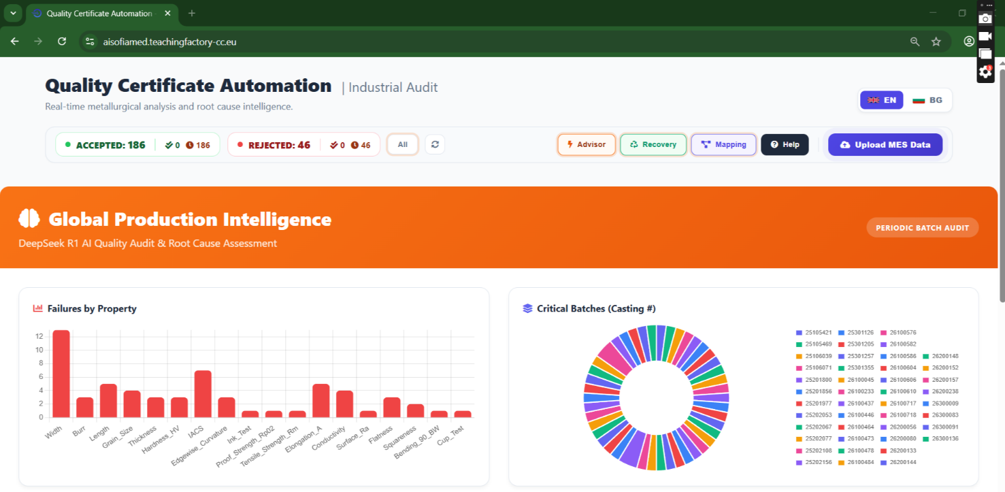
The solution under test was a FastAPI-based AI quality control automation system driven by local LLM. Supporting components included a SQLite database, Cloudflare zero-trust access control, and a bilingual (English / Bulgarian) web dashboard.
The Use case
Automated comparison of production measurement results against per-customer, per-alloy specification limits, covering chemical composition (Cu, Zn, Pb, Fe), mechanical properties (tensile strength, elongation, hardness, conductivity), and dimensional/surface characteristics. The system generates structured AI audit reports, routes decisions via fail-first logic, and triggers automated rejection email notifications.
Experiment setup
Testing was executed at LMS using SOFIA MED’s operational MES Excel exports. Three test scenario categories were run: (1) baseline testing — full pipeline correctness and consistency; (2) variable / edge-case testing — robustness under zero-value specs, invalid specifications, and non-standard naming; (3) stress testing — large batch files (200+ orders), concurrent access, and extreme deviation scenarios. In total, 232 orders were processed across all test phases.
The Impact
The experiment resulted in all five industrial KPIs and all five technical KPIs being met or exceeded:
| KPI | Target | Achieved |
|---|---|---|
| Automation coverage | ≥70% | 90% |
| Decision accuracy | ≥80% | 88% |
| Processing time per order | ≤60 seconds | 38 seconds avg |
| Rejection notification time | ≤2 minutes | <45 seconds avg |
| Audit trail completeness | 90% | 95% |
| Schema alignment accuracy | >90% | 93% |
| LLM compliance reasoning accuracy | >80% | 87% |
| Pipeline completion rate | ≥95% | 96% |
| Edge-case handling correctness | >90% | 94% |
| System traceability | 100% | 100% |
Processing time was reduced from 3–5 minutes per order to 38 seconds on average, an approximately 88% batch time saving. For a standard 50-order batch, total QC processing time dropped from 275–325 minutes to approximately 32 minutes.
SOFIA MED received a full validation report with test results, KPI evidence, and implementation recommendations, enabling informed decision-making on production go-live.
Key Insights
- On-premise LLM inference is both technically viable and operationally necessary for data-sovereign industrial deployments; all customer specifications and metallurgical data remain within the organisation’s server infrastructure.
- Schema alignment is the critical first enabler: a one-time investment in column mapping unlocks full automation across all customer specification variants without IT involvement.
- Human-in-the-loop design is a strength, not a constraint: it enables QC engineers to focus on borderline cases (12% of decisions) while routine comparisons are fully automated.
- Material Recovery Hub and Root Cause Advisor deliver significant additional value beyond the core QC decision workflow, enabling scrap reduction and systematic production process improvement.
- The 12% of decisions requiring human review were concentrated in borderline deviation cases (within 0.5% of specification limits): a well-defined boundary that confirms the right scope for human oversight.
What’s next?
SOFIA MED plans full production deployment of the validated AI QC system within the next 12 months, including:
- Direct MES API integration to eliminate manual Excel uploads.
- Expanded schema mapping for all active customer profiles.
- Schema rollout to additional product lines: tubes and rods, and specialty alloy products.
- Evaluation of AI-guided robotics integration as a longer-term initiative.
- SOFIA MED has also expressed willingness to serve as a reference customer and case study for TF-CC/LMS in extending this service to other metal manufacturers.
Why AI-MATTERS?
AI-MATTERS enabled SOFIA MED to:
- Test an AI quality control solution in a real, production-representative environment using their own operational data, with no upfront infrastructure investment.
- Access expert AI deployment and validation support from TF-CC/LMS, combining AI engineering expertise with deep manufacturing domain knowledge.
- Validate measurable impact before committing to full production deployment, with a structured KPI framework covering both industrial and technical performance dimensions.
Through collaborative experimentation, SOFIA MED moved from idea to validated solution with significantly reduced risk and uncertainty, and a clear, evidence-based path to production go-live.panies can move from AI prototypes to technically validated solutions with increased confidence.
FAQs
The service “Automated Quality Control using AI-Driven Audit Reports and LLM-Based Decision Support in Metal Manufacturing”, delivered by the Teaching Factory Competence Centre (TF-CC) at the Laboratory for Manufacturing Systems & Automation (LMS), University of Patras, under the AI-MATTERS framework.
Through AI-MATTERS, manufacturing companies can access structured testing and validation services in real production environments. The process includes defining the use case, preparing representative operational data, running baseline and stress experiments, and receiving a full KPI-based validation report — all without upfront investment in production infrastructure or deployment risk.
For more information and a specific dive into your use case, we welcome you to contact us for a non-binding conversation.
Yes. The SOFIA MED case demonstrates that LLM-driven QC can handle multiple customers, multiple alloy grades, and varying Excel column naming conventions through schema alignment and synonym resolution. The system achieved 93% schema alignment accuracy and 88% overall QC decision accuracy across all customer specifications tested — with remaining mismatches resolvable via a no-code column mapping interface.
About the Author
Teaching Factory Competence Centre (TF-CC) — Laboratory for Manufacturing Systems & Automation (LMS), University of Patras. The TF-CC team specialises in the co-design, validation, and deployment support of digital and AI solutions for industrial process automation, quality management, and operational decision-making. AI-MATTERS activities at LMS include KPI-based evaluation, experimental protocol design, and the packaging of validated methods into repeatable service offerings for manufacturing companies.



Would you like to know how our project managers can help your organisation?
Contact us for a non-binding conversation: https://ai-matters.eu/contact/