What is AI-enabled visual inspection and how does it help you validate your assembly before investing?
AI-enabled visual inspection is a computer-vision service that automatically checks an assembled product against its DXF design file. It verifies that every component is present, of the correct type and in the correct position before the product leaves its workstation – reducing manual inspection workload, catching defects early, and giving manufacturers measurable proof of quality before they invest in full deployment.
What does this service entail?
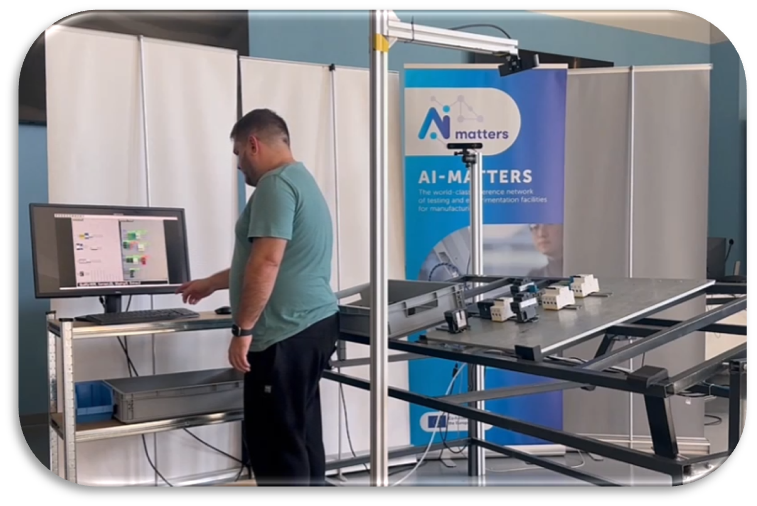
AI-enabled visual inspection of electrical cabinets is a service that supports manufacturers in automatically validating the completeness and correctness of assembled products using computer vision and AI. It compares each assembled panel against its product-specific design (.DXF) file and flags missing, extra or misplaced components.
It is designed for:
- Small, medium and large-sized manufacturers running assembly lines with frequent, manual quality checks
- Innovation leaders, production and quality managers who want to reduce inspection time and rework
AI and machine-vision technology providers who want to test and mature inspection solutions in real industrial settings
The service focuses on enabling organisations to evaluate an AI inspection solution in a real production environment before making investment or scaling decisions.M-powered compliance analysis, structured audit report generation, and human-in-the-loop review.
Why is the service important?
In customised assemblies – such as elevator electrical panels – every product is built to a specific design, and a skilled operator must manually verify each one. Many manufacturers struggle with this because:
- Manual inspection is slow and depends on the availability and attention of a high-skilled operator
- Defects are often detected late, forcing products back to earlier workstations and increasing cycle time and rework
- Inspection accuracy, latency and the ability to reconfigure to new designs are hard to measure objectively
Without proper validation, AI inspection projects risk failing or not delivering the expected return.
How does the service work?
The service typically follows these steps:
- Define the inspection use case, target products and quality criteria
- Provide the relevant design files (e.g. .DXF) and representative assembly scenarios
- Set up a testing environment on or alongside the production line, with minimal changes to existing infrastructure
- Capture real product images and train and validate the AI detection and segmentation models
- Run the inspection pipeline under realistic conditions and compare results against manual inspection as ground truth
- Evaluate performance against agreed industrial and technical KPIs
- Deliver a validation report, feasibility assessment and recommendations for next steps
What are the benefits?
The experiment resulted in all five industrial KPIs and all five technical KPIs being met or exceeded:
| For SMEs | For innovators and system integrators | For technology providers |
|---|---|---|
| Validate AI inspection without a large upfront investment | Reduce inspection time and rework, supported by measurable data | Test and mature solutions in a real industrial environment |
| Catch assembly defects before products leave the workstation | Build an internal business case backed by KPI results | Progress product maturity (TRL) toward deployment |
| Reduce rework and operational risk | Reduce uncertainty before scaling | Gain independent proof-of-concept validation |
When should you use this service?
This service is most relevant when:
- You perform manual quality inspection on customised or variable assemblies
- You want to reduce inspection time, rework and dependency on expert operators
- You need to validate an AI inspection solution before investing
- You need objective evidence and KPIs to support a quality controls decision
Example use cases
- AI-based quality inspection of assembled electrical panels and cabinets
- Component presence, type and placement verification against CAD/DXF designs
- Automated defect detection at assembly workstations before products move on
- Inspection solutions that reconfigure automatically to new product designs.
Key Insights
Based on testing and experimentation in a real production environment, companies often learn that:
- AI inspection works best when applied to clearly defined, design-driven use cases
- Comparing detected components directly against the design file is a robust, transparent way to score quality and guide operators
- Real-world testing is essential – models that perform well in the lab must still prove robust under industrial lighting and layout variation
- A standard camera setup is enough to validate the concept, while industrial-grade hardware strengthens reliability for continuous 24/7 use
Why AI-MATTERS?
AI-MATTERS provides:
- Access to real production environments, such as KLEEMANN’s electronics plant in Kilkis, Greece
- Representative data, design files and use cases for experimentation
- Expert support for experiment design, model validation and KPI measurement
This allows companies to move from idea to validated solution with reduced risk. In this validation, the service reached 96.4% inspection accuracy and cut inspection time per panel, with all industrial and technical KPI targets met or exceeded.
FAQs
Through AI-MATTERS you can run a structured experiment in a real production environment using your own or representative industrial data, with expert partners measuring performance against agreed KPIs – so you see concrete results and a feasibility assessment before committing to a full investment.
A customised test setup on or alongside the line, AI model training and validation on a representative dataset, a defined set of industrial and technical KPIs, multiple evaluation runs against manual inspection as ground truth, and a final validation report with a feasibility assessment to support decision-making.
In this validation it reached 96.4% accuracy compared with manual inspection, with a 100% true-positive detection rate and 99% overall component-detection accuracy.
SMEs and larger manufacturers running customised assembly lines, their innovation and quality leaders, and AI or machine-vision technology providers who want to mature their inspection solutions in a real industrial setting.
Interested in testing or validating AI in your production environment?
Explore how AI-MATTERS can support your use case by leaving your contact information below. Our expert team will help you define your use case and design a validation experiment tailored to your production context
👉 https://ai-matters.eu/contact/