Now open · EU consultation Share your views on AI adoption in manufacturing: open until 30 October 2026 Take the questionnaire ›

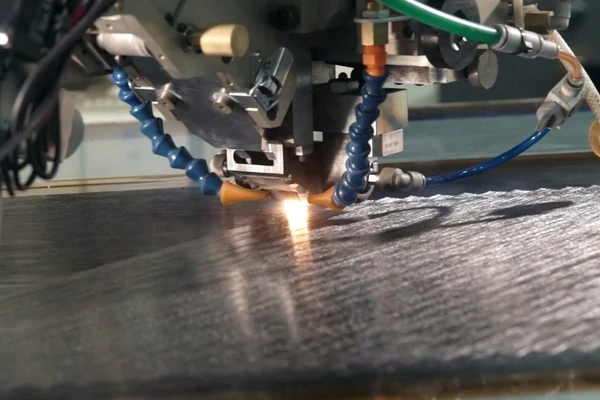
This service evaluates and optimises advanced control and path planning algorithms for Automated Fibre Placement (AFP) processes, helping companies improve manufacturing quality, reduce defects, and increase process efficiency. It enables developers and manufacturers to validate their strategies before full-scale industrial deployment.
The service assesses the performance of customer-developed path planning and control algorithms in a real AFP cell, analysing their impact on manufacturing outcomes. Testing focuses on key aspects such as trajectory accuracy, fibre placement quality, defect generation, process stability, and overall part integrity.
The evaluation is carried out under representative manufacturing conditions, allowing companies to identify issues related to path strategies, such as gaps, overlaps, fibre wrinkling, or deviations from the desired geometry. This supports the optimisation of algorithms to improve final part quality and reduce material waste.
The result is a technical report describing:
Additionally, the service includes the generation of datasets for evaluating quality inspection algorithms in AFP processes. In-situ inspection using laser profilometry systems during the AFP process enables the acquisition of high-quality datasets for defect detection and classification.
In these cases, the output includes:
The service follows a structured process:
Typical applications include optimisation of composite manufacturing processes, validation of path planning software, and development of AI-based quality inspection systems. For example, software developers can improve path planning algorithms for complex geometries, while composite manufacturers can reduce defect rates and increase production reliability.
To carry out the service, customers are expected to provide their control or path planning algorithms, part design specifications, and, where applicable, material and process parameters. ITA provides access to the AFP cell, inspection systems, and expertise in composite manufacturing, AI, and process optimisation.
This service is designed for:
To start a project, companies can contact ITA to define the manufacturing use case and technical requirements. This initial step includes a feasibility assessment, followed by a tailored proposal, execution of trials, and delivery of results and datasets.